Correct measurement is the foundation of reliable capacitor repair work. A multimeter capacitance mode alone is rarely enough for meaningful diagnosis because it usually measures at one low frequency and does not reveal ESR, leakage current, or high-frequency behaviour.
Safety, Discharge & Test Setup
Before any measurement, make sure the equipment is unplugged, high-voltage rails are safely discharged, and large bulk capacitors are bled down with an appropriate resistor, not by shorting them with a screwdriver. Mains-side electrolytics in SMPS units can hold hundreds of volts for several minutes after power-off, so always verify with a meter before touching the board.
When doing in-circuit tests, keep one hand in your pocket around live or previously live power supplies, use insulated probes, and never rely on low-voltage test instruments to protect you from charged capacitors or mains potentials. If you are unsure whether a node can still be energized, treat it as live and discharge or isolate it first.
What Makes a Cap “Healthy”?
For aluminium electrolytic and polymer capacitors the key health indicators are capacitance, ESR (equivalent series resistance), leakage current, and sometimes dissipation factor and impedance versus frequency. A capacitor can still read close to its nominal capacitance yet have ESR several times higher than specified, which will increase ripple and heating in switching supplies.
Datasheets usually specify capacitance and dissipation factor at 120 Hz or 100 Hz and leakage current at the rated working voltage after 1–2 minutes, while ESR for low-impedance series is often quoted at 100 kHz as a reference point for switch‑mode applications.[web:3][web:4][web:6] Comparing your measurements to these conditions is essential; arbitrary limits that ignore datasheet test conditions can be misleading.
ESR Meter: Fast Health Check for Electrolytics
An ESR meter applies a small AC test signal and measures the resistive component of the capacitor’s impedance, presenting it directly as ESR in ohms. Most dedicated ESR meters, such as the Peak Atlas ESR70, use a test frequency in the 50–100 kHz range with a typical test voltage of only a few tens of millivolts.[web:1][web:4][web:10] At these frequencies, the reactance of electrolytics above about 1 µF is very small, so the measured impedance is dominated by ESR.[web:4]
Because the test voltage is low (around 40 mV across the internal sense resistor in the ESR70), semiconductor junctions on the board are not forward-biased and many capacitors can be measured in-circuit without lifting a lead.[web:1][web:4] However, parallel capacitors will appear as one larger capacitor with a lower combined ESR, and parallel resistors or low-impedance paths can make a bad capacitor look better than it really is, so suspicious readings still need confirmation out-of-circuit.
Manufacturers usually quote ESR at 100 kHz for low-impedance aluminium electrolytics, which aligns with the test frequency of common ESR meters and allows you to compare readings directly to datasheet tables.[web:4] Some older or general-purpose parts specify ESR at 100 Hz or 120 Hz; the absolute value will differ, so always compare like-for-like conditions rather than mixing frequencies.[web:4]
For hobby work, typical ESR meters include the Peak Atlas ESR70, various MESR-100 variants, and ESR functions built into better LCR meters.[web:1][web:4][web:10] Calibrate your meter or at least sanity-check it against a known-good capacitor from a reputable series before starting a repair session so you know the instrument and leads are behaving sensibly.
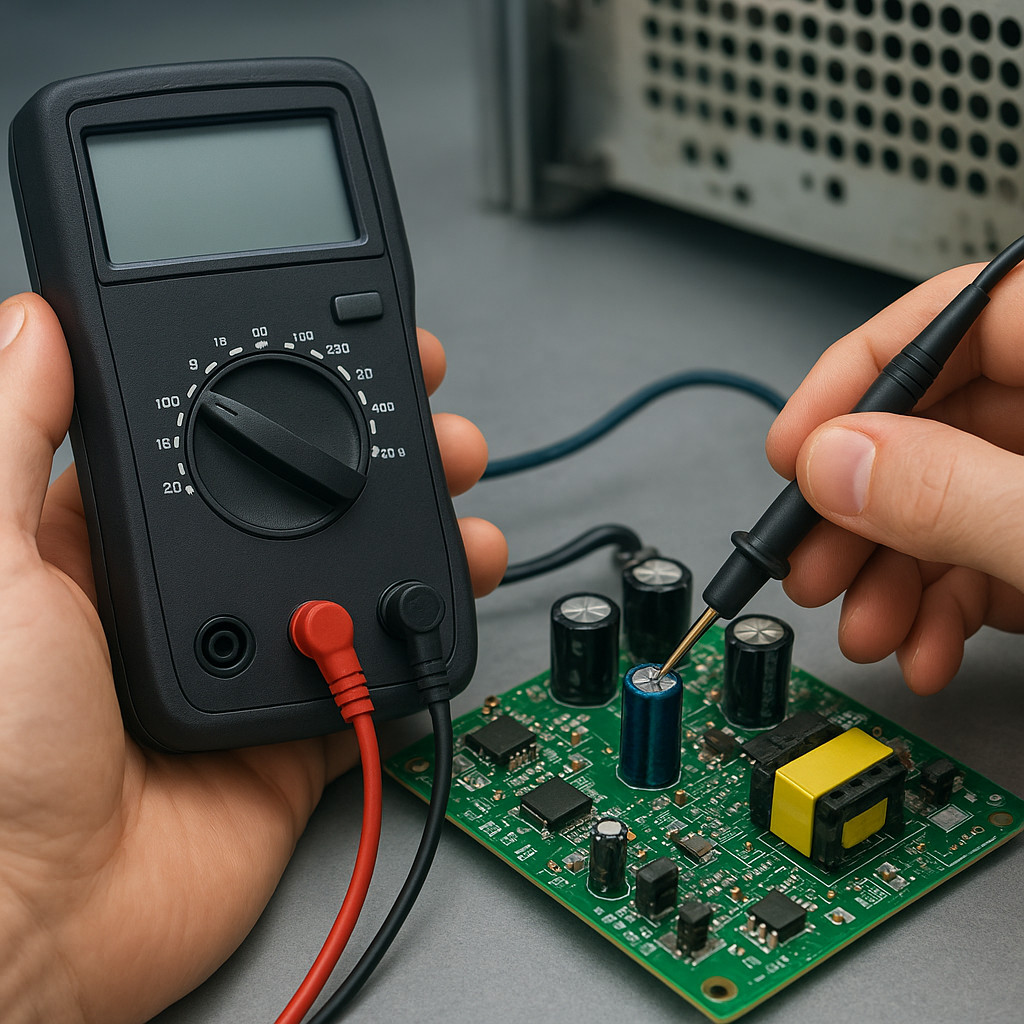
LCR Bridge for Precise Out-of-Circuit Measurement
An LCR meter (or LCR bridge) can measure inductance (L), capacitance (C), resistance (R), dissipation factor (D or tanδ), and sometimes impedance and quality factor across several test frequencies. Serious instruments such as the DE-5000 let you choose frequencies like 100 Hz, 120 Hz, 1 kHz, 10 kHz and 100 kHz, which match typical datasheet conditions for capacitance and ESR.[web:4]
Out-of-circuit testing with an LCR meter provides the most accurate picture of a capacitor’s condition because parasitic paths on the PCB are removed. You can directly compare capacitance, ESR, and dissipation factor against datasheet limits at the same frequency and temperature, and you can also see how ESR and impedance change across frequency to judge suitability for VRM output filtering or bulk rectifier smoothing.[web:3][web:4]
Use 120 Hz (or 100 Hz, depending on the datasheet) for checking capacitance value and dissipation factor, especially for mains-frequency filter capacitors.[web:3][web:6][web:12] Use 10–100 kHz for ESR and impedance checks on low-ESR series intended for switch‑mode power supplies, since this better reflects their behaviour at switching and ripple frequencies.[web:4]
In-Circuit vs. Out-of-Circuit Measurement
In-circuit ESR measurements are excellent for quick triage: you can rapidly scan banks of electrolytics on a motherboard or power supply and flag obvious outliers without desoldering every part. If one capacitor in a parallel bank has gone open-circuit or high ESR while the rest are still good, the parallel combination may still read close to the expected ESR, so do not assume that a “good” in-circuit reading means every individual capacitor is fine.
Capacitors in series with inductors (for example in PI filters or LC output stages) can sometimes be measured in-circuit at high test frequencies because the inductor presents a high impedance, so it does not significantly shunt the measurement. However, any low-resistance path in parallel, such as bleed resistors, protection circuitry, or other capacitors, can lower the measured ESR and hide faults. Out-of-circuit measurement remains the gold standard when you need certainty.
Leakage Current & Insulation Testing
Leakage current is the DC current that flows through a capacitor when a constant voltage is applied; excessive leakage indicates dielectric degradation or internal damage. Many aluminium electrolytic datasheets specify leakage as I ≤ 0.01 C V (in µA) or a slightly larger multiple, measured after 1–2 minutes at rated voltage, with a small absolute floor current.[web:3][web:6][web:9][web:12] For example, a 1000 µF, 25 V capacitor with a limit of 0.01 C V would be allowed roughly 250 µA of leakage current after the stated time.[web:3][web:6][web:12]
To measure leakage safely, connect the capacitor out-of-circuit to a current-limited bench supply with an ammeter in series, slowly raise the voltage up to (but not beyond) its rated working voltage, and allow a few minutes for the dielectric to reform. Do not use an arbitrary fixed threshold such as “under 100 µA at rated voltage” for all parts; large, high-voltage capacitors legitimately have higher allowable leakage than small, low-voltage ones, and the correct limit must come from the datasheet formula.[web:3][web:6][web:9][web:12]
If leakage is significantly above the specified limit even after several minutes at voltage, the capacitor should be considered suspect or failed. Long-stored electrolytics can sometimes recover after a controlled reforming process where rated voltage is applied through a series resistor for an extended period, but this is best reserved for new‑old‑stock parts rather than salvaged capacitors from failed equipment.[web:3][web:6][web:15]
Temperature, Aging & Reforming Effects
ESR and leakage are strongly temperature-dependent: ESR generally increases as capacitors run colder and decreases as they warm toward their rated temperature, while leakage current rises with both applied voltage and temperature.[web:3][web:6][web:15] Measurements taken on a cold workshop bench will not perfectly match datasheet values specified at 20–25 °C, so allow for some deviation and focus on large outliers rather than chasing small differences.
Electrolytic capacitors that have been stored for years without voltage can exhibit temporarily high leakage currents because the oxide dielectric has partially degraded; applying the rated voltage through a resistor for an hour or two can reform the dielectric and reduce leakage toward the specified limit.[web:3][web:6][web:15] However, capacitors taken from obviously failed equipment (bulging vents, electrolyte residue, burnt boards) should be replaced rather than reformed, even if leakage improves.
Assessing Ripple with an Oscilloscope
ESR and leakage tests tell you about the capacitors themselves, but an oscilloscope shows how the entire power stage behaves under load. To check ripple on a DC rail, use a x10 probe, keep the ground lead as short as possible (or use a spring ground), set the scope to AC coupling, limit bandwidth to 20 MHz if possible, and probe at the load or at the output connector rather than deep inside the PSU wiring.[web:5][web:14]
For PC ATX12V supplies, the design guide specifies a maximum of 120 mV peak-to-peak ripple and noise on 12 V rails and 50 mV peak-to-peak on 5 V and 3.3 V rails over a 10 Hz–20 MHz bandwidth.[web:2][web:8][web:11][web:14] Many high-quality PSUs and VRM stages on modern motherboards comfortably achieve ripple well below these limits (often under 20–30 mV on 12 V rails at moderate loads), so ripple approaching the specification maximum is usually a sign that filtering is marginal or capacitors are aging.[web:8]
Measure ripple at both light and heavy load: high ripple at light load can point to control-mode quirks or inductor issues, while ripple that only rises sharply at high load often implicates degraded output capacitors or insufficient bulk capacitance. Always confirm that your measurement setup (bandwidth limit, probe grounding, and any tip adapters) is not injecting extra noise or overshoot before condemning hardware.[web:5][web:14]
Measuring Small MLCCs & Polymer Caps
Cheap ESR meters are optimised for aluminium electrolytics in the 1 µF–20 000 µF range and are not very useful for small ceramic capacitors or very low-ESR polymer types.[web:1][web:4][web:10] For multi-layer ceramic capacitors (MLCCs) in decoupling networks, an LCR meter with SMD fixtures or tweezers is far more appropriate, and you often have to lift at least one end of the capacitor because they are densely paralleled on modern boards.
Solid polymer capacitors have much lower ESR than liquid electrolytics and often maintain their ESR over a wider temperature and frequency range, so you should expect ESR values significantly lower than those of an aluminium electrolytic of the same capacitance and voltage rating.[web:3][web:9] When in doubt, consult the polymer series datasheet and compare your ESR, ripple-current rating, and impedance curves to ensure that a chosen replacement really matches or exceeds the original performance.
Simple Pass/Fail Criteria for the Hobby Workshop
For quick triage, use the manufacturer’s ESR and leakage specifications rather than arbitrary absolute numbers. A practical rule of thumb is: if the measured ESR is more than about two to three times the datasheet maximum at the same frequency and temperature, or if leakage current significantly exceeds the I ≤ k C V limit after the specified time, the capacitor is a strong candidate for replacement.[web:3][web:4][web:6][web:9][web:12]
Capacitance alone is a weak discriminator because many failing electrolytics remain within ±20 % of nominal while ESR and leakage are already out of spec.[web:3][web:6] Still, any large electrolytic that has lost more than about 20–30 % of its capacitance compared to the nominal value at the datasheet test frequency is generally not worth keeping unless there is an exceptional reason.
As a functional system-level check, powering a board from a current-limited bench PSU can quickly reveal gross problems such as shorts or heavily degraded bulk capacitors. Set the voltage to the correct rail value, start with a conservative current limit, and slowly increase it while watching both current draw and output ripple on the scope rather than relying on an arbitrary 1 A limit; different boards naturally draw very different currents, so there is no single universal current value that separates good from bad behaviour.[web:5][web:14]
| Test | Tool | Indicative Good Result |
|---|---|---|
| ESR quick-check (electrolytics) | ESR meter @ ≈100 kHz | Measured ESR within about 2–3× of datasheet max at same frequency and temperature.[web:3][web:4] |
| Capacitance verify | LCR meter @ 100/120 Hz | Within datasheet tolerance (typically ±20 %) at specified frequency and 20–25 °C.[web:3][web:6][web:12] |
| Leakage current | Bench PSU + ammeter | Below datasheet limit, often I ≤ 0.01 C V (in µA) or similar after 1–2 minutes at rated voltage.[web:3][web:6][web:9][web:12] |
| Ripple on 12 V rail (PC PSU) | Oscilloscope, 20 MHz BW | < 120 mVp‑p to meet ATX spec; good designs often < 20–30 mVp‑p at moderate load.[web:2][web:8][web:11][web:14] |