Modern electrolytic and polymer capacitors look similar from the outside, but their internal construction differs fundamentally. Knowing those differences prevents costly mistakes during a recap or upgrade project.
Electrolytic vs. Polymer: What Actually Differs
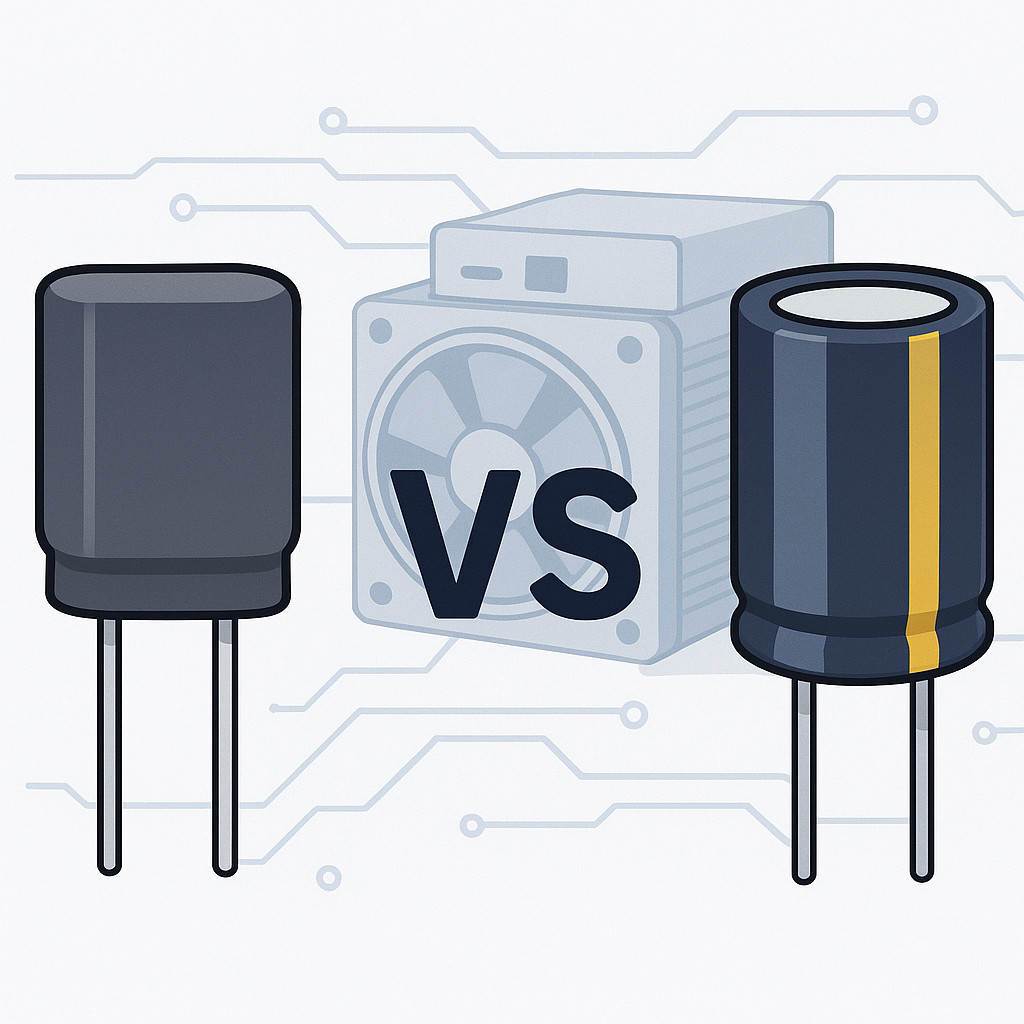
Standard aluminum electrolytic capacitors use a liquid electrolyte between two aluminum foil layers. This liquid can dry out over time, especially at elevated temperatures, causing capacitance to drop and ESR to rise sharply.
Polymer capacitors replace the liquid electrolyte with a solid conductive polymer film. This gives them a dramatically lower ESR and virtually eliminates the drying problem. Their lifespan is significantly longer at identical operating temperatures.
ESR – The Most Important Parameter
ESR stands for Equivalent Series Resistance. It is the parasitic resistance that appears in series with the ideal capacitance. A high ESR turns electrical energy into heat and degrades filtering performance.
For CPU voltage regulators and GPU power stages, ESR in the range of 5–20 mΩ is considered low. A failing electrolytic cap can reach 500 mΩ or more, which is enough to cause system instability.
Ripple Current Rating
Ripple current is the AC component flowing through a capacitor while it filters a DC rail. Exceeding the rated ripple current causes self-heating inside the cap. This accelerates electrolyte evaporation and shortens lifespan.
Always choose a replacement cap with a ripple current rating equal to or higher than the original. For polymer caps this is rarely a concern, since they typically offer two to four times the ripple rating of equivalent electrolytics.
Temperature and Lifespan Ratings
Capacitor lifespan follows the Arrhenius equation: every 10°C rise in operating temperature roughly halves the expected lifespan. A 1000-hour cap at 105°C may last 16,000 hours at 65°C.
Most consumer-grade caps carry a 2000-hour or 3000-hour rating at 105°C. Premium Japanese brands often offer 5000- or even 10,000-hour ratings. Always match or exceed the temperature rating of the original component.
Reading a Datasheet Correctly
The key fields to check on any datasheet are: rated capacitance and tolerance, rated voltage, ESR at 100 kHz, maximum ripple current, operating temperature range, and expected lifespan at maximum temperature.
Never operate a capacitor above 80% of its rated voltage in a continuously powered circuit. Derating protects the dielectric layer and extends service life significantly.
| Parameter | Electrolytic | Polymer |
|---|---|---|
| ESR at 100 kHz | 30–200 mΩ | 3–30 mΩ |
| Lifespan (105°C) | 1000–5000 h | 2000–15000 h |
| Failure mode | Dry-out, bulge | Gradual parameter drift |
| Typical application | Bulk filtering, audio | VRM output, GPU |
With these fundamentals in hand, you are ready to evaluate replacement options for any recap project. The next step is understanding how to identify failed caps on a board and select correct replacements.